

The Great Breakthrough in Sports Policy
Klebelsberg, Minister of Sport
Szerző: Csillag Péter
Megosztás
Hungarian sports policy during the interwar period was marked by a fundamental change in perspective. Under the purview of the minister of religion and education, Kuno Klebelsberg, physical education was treated as a forced alternative to military training—which had been drastically curtailed following the Treaty of Trianon—with the promotion of sports viewed as a cultural mission. A visionary patron of Hungarian sports, Klebelsberg is credited with—among other things—introducing the Physical Education Act, establishing the College of Physical Education, fostering the Levente youth movement, encouraging mass sport, establishing numerous sports facilities, promoting the international expansion of Hungarian sports diplomacy, and announcing the first Physical Education Congress.
“Until now, no one in Hungary could ever lay claim to the title of minister of sport—not in the old days, nor in recent times. That is, until today. And yet, sport is not a recent phenomenon for us; we look back to the 1870s when writing of its birth, and our ministers have not been appointed just since yesterday but ever since the days of the ill-fated Lajos Batthyány. We have been waiting – if not since 1875, then certainly for quite some time – for sports and a minister to finally find each other or—at the risk of a slight exaggeration—a people and their leader. We had to wait a long time.”
![Commissioned by Kuno Klebelsberg, the 1930 National Physical Education Congress in Szeged aimed to establish a new national tradition. Speakers at the event included Albert Szent-Györgyi, a doctor and professor, who spoke on the unity of physical and intellectual education; Sándor Sík, a priest, poet, and Piarist teacher, who discussed the beneficial role of the scouting movement in youth education and development; and Gyula Vadas, editor-in-chief of Nemzeti Sport [National Sport], who emphasized the importance of promoting rural sports](https://rubiconintezet.fra1.cdn.digitaloceanspaces.com/media/1_orsz_testnev_kongr_1930_plakat_f6cc2304_1e08_4a69_b430_8a95c5dae932_in_content_c818ace3c3.webp)
Commissioned by Kuno Klebelsberg, the 1930 National Physical Education Congress in Szeged aimed to establish a new national tradition. Speakers at the event included Albert Szent-Györgyi, a doctor and professor, who spoke on the unity of physical and intellectual education; Sándor Sík, a priest, poet, and Piarist teacher, who discussed the beneficial role of the scouting movement in youth education and development; and Gyula Vadas, editor-in-chief of Nemzeti Sport [National Sport], who emphasized the importance of promoting rural sports
The above was from the editorial of the August 23, 1929 issue of the newspaper Nemzeti Sport about Klebelsberg, who was not officially the minister of sport but in practice very much deserved the title. Both as minister of the interior from December 1921 to June 1922 and as minister of religion and public education from June 19 until August 1931, he devoted particular attention to physical education.
A personal relationship with sports
Klebelsberg had relatively little personal experience with sports, and what he did have was mainly limited to the leisure activities popular among the upper classes at the time. He was a passionate hunter, skilled with both rifle and pistol. In July 1922, he fought a duel with Count György Pallavicini after Pallavicini questioned Klebelsberg’s masculinity in a speech to the National Assembly. The pair exchanged two rounds from a distance of thirty paces, and although no blood was drawn, the two men remained unreconciled.
He was an avid chess player, so much so that in 1927 he accepted the position of honorary patron of the Hungarian Chess Federation. This was due in part to his standing as an “expert practitioner of this noble game”—as the Pesti Napló newspaper reported at the time—and partly because the Hungarian chess community viewed him as “the first statesman to recognize and duly appreciate the cultural significance of chess.” His widow, Sarolta Ottília Klebelsberg, née Botka, recounted his childhood and teenage sporting experiences in her memoir Életutunk [Our Life Journey]:
“He remained in Fehérvár only for Christmas and Easter, retreating to the villa on the banks of the Sió for his summer breaks. This was his form of recreation. Such moments found him inseparable from his Uncle Kamill [his guardian and uncle, Kamill Scherer, a court judge]. Together they would read Goethe and Shakespeare, take walks, hunt, target shoot, play chess and cards, and enjoy each other’s company. Kunó was a quick learner and mastered everything. Uncle Kamill was a noted hunter in Fejér County, and he taught his ward how to hunt and use a rifle from an early age. Kunó kept a hunting diary from the age of seven, recording how many sparrows, frogs, and so on he had shot, and he maintained it with the same accuracy and meticulousness as his later records, notes, and statistical tables. By then, shooting through a four-kreuzer coin tossed in the air and sniping small fish lurking in the Sió had become second nature to him; together they would often bag a half dozen birds from a flushed covey of partridges. […] Kunó attained such mastery at chess that he could play entire matches from memory—without seeing the board—announcing his moves from an adjacent room. His talent for cards, meanwhile, was such that in his later years he became one of the finest bridge players in the country. In the final year of his life, the Hungarian Bridge Club approached him, asking that he accept the presidency. As a young boy, he joyfully embraced every holiday—walking and playing tennis—but his greatest joy was rowing out onto the water of Lake Balaton for hours on end in his little boat, the Krampusz.”

Kuno Klebelsberg (right) chatting by the poolside with Béla Komjádi (1892–1933), the legendary Hungarian water polo coach. Under Komjádi’s leadership, the Hungarian national team won its first Olympic gold medal in Los Angeles in 1932. The minister had a particularly close connection to water polo; starting in 1929, an international competition was held bearing his name—the Klebelsberg Cup
The Hungarian public knew little about Klebelsberg’s solitary jaunts on the Balaton in his youth, though his passion for rowing off the shore of the Tihany Peninsula remained with him his entire life. It is telling that following his death in 1932 at the age of 56, Nemzeti Sport described him as a “non-athlete” or “outsider” in its front-page obituary.
“Kuno Klebelsberg was not an athlete. During his first years as a minister, he had little to do with sports. But then he became involved with one of the greatest social movements of our time, and with true statesmanlike instinct and vision—such far exceeding most of our other politicians – he assumed leadership of a sports movement that still required a great deal of support, understanding, and tolerance, and in doing so, he ushered in a new era. And he created such an era because—by following his example—it became fashionable to pursue sports. But Klebelsberg did not stop at providing salutary moral support and fleeting exhortations. He took action—and in doing so, he did a great deal for Hungarian sport.”
His role in the Levente youth movement
To rebuild a country mutilated in both territory and population in the wake of Trianon and to restore a nation reeling from a historical catastrophe was the primary focus of Hungarian political thinking in the 1920s. The difficulties were compounded by the restrictions set forth in the peace treaty, which capped the country’s armed forces at 35,000 men, abolished conscription, and rendered general military training impossible.
It is largely to Klebelsberg’s credit that, despite the dire circumstances, he found an alternative way to provide Hungarian youth with physical training and national defense education: through the means of school physical education and sports, he sought to train combat-ready masses in a thinly veiled manner and to instill a soldierly spirit.

The Hungarian Olympic Society, which brought together former Olympic medalists, held its inaugural meeting in April 1932 and elected Kuno Klebelsberg as its president
The Levente youth movement provided the recruits for this “reserve army” dressed in gym uniforms. From 1921, he made extracurricular physical training compulsory by law for boys ages 12 to 21 who were not enrolled in school-based physical education. At the same time, Klebelsberg embarked upon an unprecedented wave of sports-related construction, allowing village boys, for example, to play football in places previously excluded from the organized sports network. Lajos Szabó, a sports historian and a former director of the Hungarian Olympic and Sports Museum, describes the impact as follows:
“Leaving aside the well-known and much-criticized militarist stance and later excesses of the Levente youth movement, it must be acknowledged that it played an unquestionably positive role in making sports a widespread activity among the male population up to the age of 21.”
Klebelsberg himself did not hide his true goals, as he noted in Nemzeti Sport in 1928: “The main goal of the Levente youth movement is to mobilize Hungarian youth and instill in them a disciplined and healthy way of life. And sport was involved largely because it is a magical formula that can win over every young man to the movement’s goals without the need for force or punishment.”
He set forth the conceptual foundations of his vision in a statement from December 1928: “Under Trianon, we were ordered to abolish our more than half-century-old system of universal conscription, which weakened us not only militarily but also our capacity for training and education. We must ensure that the work of physical training, previously carried out by the army for the entire male population, is now undertaken by Hungarian sport. In the unique situation in which we found ourselves as a result of Trianon, sport has an even greater significance.”

Miltiades Manno’s poster depicting the Budapest Skating Association’s ice rink in the Budapest City Park. The establishment, in operation since 1870, underwent renovation and expansion to become Europe’s largest outdoor ice rink. It was officially opened on November 27, 1926, in the presence of Regent Miklós Horthy and Minister Klebelsberg
In his book Küzdelmek könyve [Book of Struggles] published in 1929, he attempted to resolve the apparent conflict that many perceived between sports and culture: “I am well aware that here, too, I shall find myself confronted by theoretical educators who are already shaking their heads at how obsessed young people have become with sports. My ideal is not the narrow-chested, bespectacled child who spends all day hunched over a book and in whose underdeveloped chest, in our unhealthy homes, the black raven of tuberculosis soon builds its nest. In reality, there is no conflict between culture and sports; the belief in such a conflict lives only in the heads of those whose vision is obscured by a kettle hat.”
This interpretation of sports represented a shift in attitude, one consistent with the change observed in the 1920s regarding the attitude toward high culture. It was in these years that literature began to embrace the phenomena of sporting life as a subject in its own right. A seemingly incidental yet characteristic moment of this unique “emancipatory” process was the Hungary-Austria football match (5:3) in September 1927. The match was watched from the old Ferencváros stadium on Budapest’s Üllői Street by Hungarian writers Frigyes Karinthy, Zoltán Zelk, and Árpád Pásztor, as well as Lőrinc Szabó—who, inspired by what he saw, wrote the poem Futballversenyen [At a Football Match]—and Zsigmond Móricz, who compiled his impressions in a report titled Negyvenezer ember [Forty Thousand People].
At an institutional level, the cultural framing of sports was likely facilitated by the 1921 Physical Education Act, which placed the field under the jurisdiction of the Ministry of Religion and Public Education, while the intentions of the lobbying forces directly representing military interests—such as the High Command, the Ministry of Defense, and the Hungarian National Defense Association—receded into the background.
The institutionalization of sports policy
The results of Klebelsberg’s sport policy—made manifest in athletic achievements, statistics, and sports facilities, and not least through its impact on public perceptions—were undeniable. Act LIII of 1921 laid the foundations for mass sports, requiring every community to establish a Levente youth association and mandating that companies and factories employing more than 1,000 people provide their employees with opportunities for physical exercise. The policy was supported by the National Physical Education Fund, an investment vehicle established in 1924—or more precisely, reactivated after a prolonged, forced hiatus due to the war. This is how Klebelsberg evaluated the process at the first National Physical Education Congress held in Szeged in 1930:
“The law was there, but there was no funding for it. Under such circumstances—and the responsibility here lies with me—I was unwilling to implement the law for three years; I was unwilling to issue the executive decree because a practical person cannot undertake to implement something for which the necessary financial means are lacking. We established a separate department within the Ministry of Religion and Public Education for the administration of physical education, and I issued an executive decree that facilitated the formation of Levente youth associations in each municipality. We Hungarians—despite our illustrious national virtues—have one great failing. We tend to view our problems through a magnifying glass, yet when good things happen, we fail to appreciate them enough. Truly, I say to you, there is scarcely a nation in this wide world that could have created such a national organization and launched such a nationwide campaign in just five short years as the Levente movement and its organizations.”
They introduced three physical education classes per week into the curriculum, built gymnasiums at schools that previously lacked sports facilities, and in 1924 established the National Association of Secondary School Sport Circles (KISOSZ), revitalizing the competitive sports system in Hungarian schools. In 1925, the Royal Hungarian College of Physical Education was established as a training center for physical education teachers, and the decision was made to build a national stadium—though, due to a chronic lack of funding and protracted professional disputes, the Népstadion [People’s Stadium] did not open its doors until 1953. Sports infrastructure projects completed during this period include the National Sports Swimming Stadium on Margit Island, the Szeged Sports Pool, the Tihany Water Sports Center, and several stadiums, such as the Megyeri Road Stadium (UTE) and BSZKRT Sport Street Stadium (BKV Előre). An authentic picture of the construction projects of that time can be found in a 1936 article in Nemzeti Ujság [National News], which – looking back over the previous fifteen-odd years – offered the following assessment:
“Dismembered Hungary currently has 622 sports facilities, distributed as follows: 97 children’s playgrounds, 67 school sports and play areas, 1,997 athletic fields and sports grounds, 318 sports complexes or stadiums, 8 cycling tracks, 2 golf courses, 2,028 small-bore rifle ranges (target ranges) or pigeon shooting ranges, 8 racecourses, 13 ski jumps, 5 downhill ski slopes, 192 swimming pools or sand beaches, 123 competitive swimming pools, 137 riverside boathouses, 35 floating boathouses, 55 sports club buildings, 62 sports or gymnastics halls, 490 school gymnasiums, 66 tourist shelters, 26 lookout towers, 883 tennis court complexes, and 211 ice rinks.”

The purposeful support of competitive sports paved the way for Hungary’s later international successes, the impact of which extends far beyond the realm of sports. The Hungarian team achieved increasingly better results at the Summer Olympic Games during the Klebelsberg era and the years following. Hungarian athletes won 2 gold medals in Paris in 1924, 5 in Amsterdam in 1928 (including one in an art competition), 6 in Los Angeles in 1932, and 10 in Berlin in 1936. In a speech delivered at the National Physical Education Congress in Szeged in 1930, the minister drew attention to the interaction between mass sports and competitive sports:
“I am convinced that this vigorous and healthy people, who have proven themselves so outstanding in the water, will be just as good in athletics, in wrestling, and in every other field of sport. And this is what every Hungarian town in the countryside should be striving for, as we will be able to participate in the Olympic Games on a much broader scale than before, and the nation will experience that glorious moment—which it has experienced more than once in recent times—when the tricolor flag is raised and the Hungarian anthem is played more and more often at the Olympics. May God grant that it be so!”
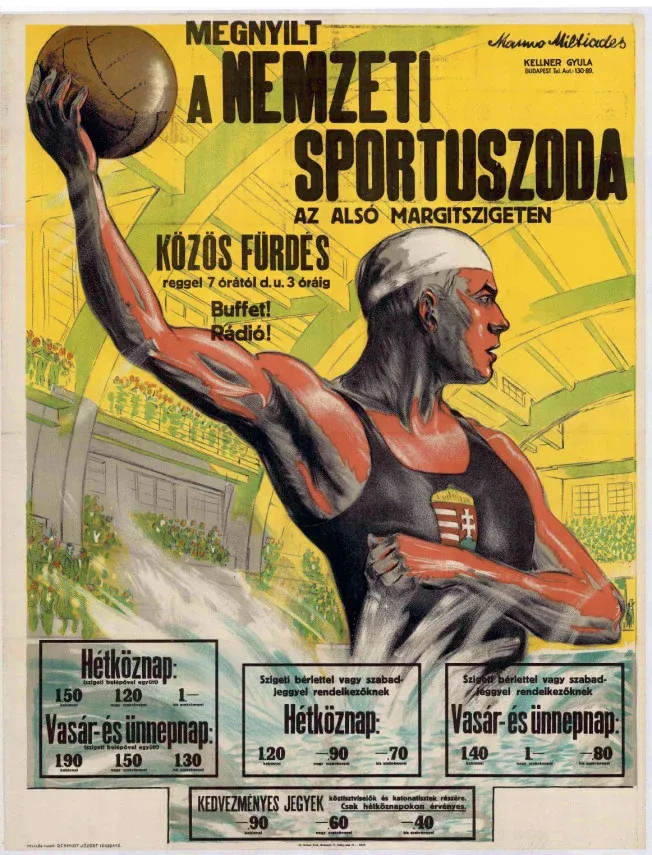
Poster announcing the opening of the National Sports Swimming Pool, 1930. The pool was designed by Alfréd Hajós, Hungary’s first Olympic champion, while the poster issued for the opening was created by Miltiades Manno (1879–1935), a graphic artist, painter, and sculptor. Manno was also the top scorer in the first two seasons of the Hungarian National Football League. Hajós and Manno were both members of the Budapest Gymnastics Club football team (BTC), which won the league championship in 1901 and 1902. Hajós went on to win a silver medal in architecture while Manno earned the silver in sculpture in the official art competitions—known as the Pentathlon of the Muses—at the 1924 Paris and 1932 Los Angeles Olympics, respectively.
In his book Világválságban [In the World Crisis], published in 1931, Klebelsberg addressed the importance of developing physical education: “We shall carry the banner of physical education throughout the country, to the very heartlands of authentic Hungarian life, where national sentiment beats most strongly, thereby further ensuring that the ideals of physical education are interwoven with the national spirit. […] This is of paramount importance in a country such as ours, where there is no universal conscription, where the national army therefore cannot undertake the athletic training of the nation’s entire male population.
“It is not enough that sporting life beats vigorously in Budapest only; it is not enough that the leaders and general public in Budapest only are interested in sports—we must make the love of sports universal throughout the entire country. The problems facing Hungarian sports must also be addressed in the major regional centers of Hungarian life; a vibrant sporting life must develop in these larger communities especially. Then our Olympians will no longer hail predominantly from the nation’s capital; instead, the most promising will be selected from a much larger population.”
The great era of competitive sports
Hungary’s efforts to deliberately expand its scope for action and strengthen its international standing also applied to the field of sports diplomacy. It is no coincidence that Hungary hosted numerous international competitions in those years, including the European championships for swimming and water polo in 1926, for fencing in 1926 and 1933, and for amateur boxing in 1930 and 1934, as well as the world championships for cycling in 1928, for table tennis in 1929 and 1931, and for gymnastics in 1934. In 1929, the “minister of sports” lent his name to an international water polo tournament (the Klebelsberg Cup). In 1930, Hungary also played host to the 19th Congress of the International Football Association (FIFA). Klebelsberg wrote about this in his work Neonacionalizmus [Neo-nationalism], published in 1927:
“The world press is full of sports news about major matches, which seem to captivate the public’s attention more than the political debates in parliaments. We are facing a vast world movement, with the issue of physical education at the forefront of modern man’s interests.”

1930 architectural rendering of the National Sports Swimming Pool, designed by Alfréd Hajós—the swimmer who won two gold medals at the 1896 Olympic Games
Given the glorious past of Hungarian swimming, it was particularly painful that there was not a single indoor swimming pool in Budapest suitable for competitions. Thus was born the idea of building the National Sports Swimming Pool. Klebelsberg also lent his support to the Hungarian Swimming Federation’s initiative. Iván Rakovszky, chairman of the Public Works Council, offered 4,000 square meters of land and hot spring water on Margaret Island free of charge. In addition, the city of Budapest and the national government each allocated one million pengős from their budgets for the construction of the swimming pool.
On September 2, 1929, Hungary’s first Olympic champion, Alfréd Hajós, won the design competition for the new pool; he was also commissioned by Klebelsberg to oversee the construction. Klebelsberg himself performed the groundbreaking ceremony on March 17, 1930, in the presence of representatives of sports bodies and the press; just seven months later, on December 7, 1930, the regent, Miklós Horthy, was present to inaugurate the new National Sports Swimming Pool. The new facility, with its 33-meter long and 18-meter wide swimming pool, was considered Europe’s largest indoor aquatic center. Klebelsberg, speaking at the inauguration ceremony of the Margaret Island swimming pool, offered a precise summary of his long-term vision when he said:
“My pedagogical ideal is not the short-sighted child who spends all day hunched over books, who tells tales to make himself look better; I want us to raise people for our homeland who are not only learned but also physically strong, honest, outspoken, and truthful—because only such a generation can lead the Hungarian cause toward its great national goals.”
(translated by John Puckett)